How do I know if I have mold in my home or business?
How Do You Know If There Is Mold in My Home or Business?
Mold is one of the most talked-about, least understood problems in real estate. Here's what actually causes it, what it does to the people who breathe it — and why testing usually isn't the first step.
Every stain, smell, or discolored patch raises the same question — and the instinct to "get it tested" is usually the wrong first move.
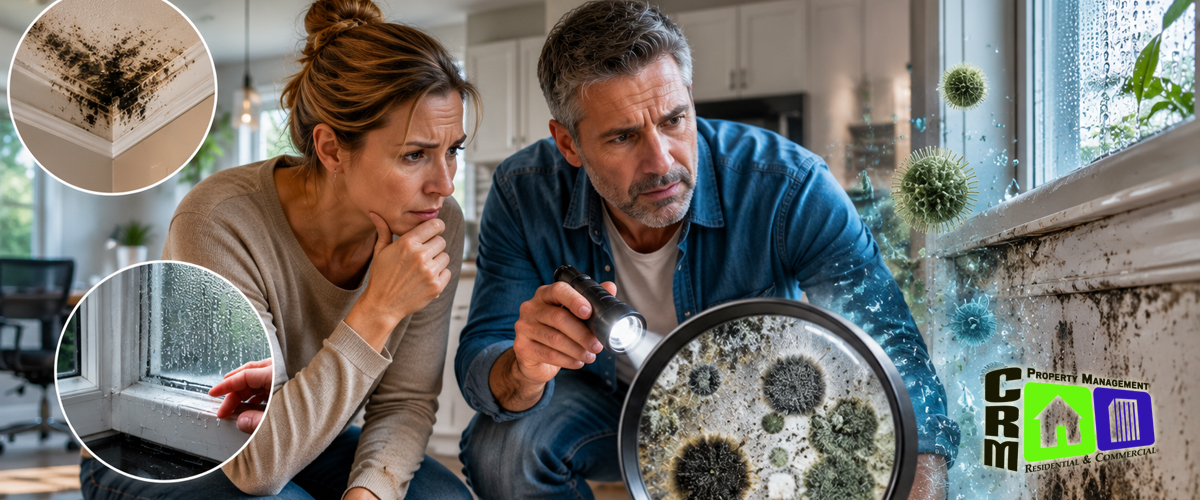
Every property owner eventually asks some version of the same question: is that stain, that smell, that patch on the bathroom ceiling actually mold — and if it is, how bad is it? The honest answer is more nuanced than most articles let on. Mold is not rare, exotic, or always dangerous. It is a normal part of every indoor and outdoor environment, and the real issue is almost never whether mold exists somewhere in a building — it's whether it's actively growing indoors, why, and what that means for the people breathing the air.
01What Mold Actually Is
Mold is a fungus, not a bacteria or a plant. It survives by digesting organic material and reproduces by releasing microscopic spores that travel through the air, settle on surfaces, and wait for the right conditions to grow. Those spores are already in every home and business, all the time — they arrive through open doors and windows, on clothing and shoes, and through HVAC systems. Mold cannot be permanently eliminated from an indoor environment. It can, however, be prevented from colonizing and growing — and that distinction is the entire game.
02What Causes It to Grow Indoors
Mold needs three things: a food source (nearly any organic building material qualifies), oxygen, and moisture. Moisture is the only one a property owner can actually control — which is why every prevention strategy comes down to moisture management.
Hidden leaks
Slow plumbing or roof leaks behind walls are the single most common cause of serious indoor mold.
Condensation
Poor ventilation in bathrooms, kitchens, and laundry rooms lets humid air condense on cool surfaces.
High humidity
Indoor relative humidity above roughly 60% creates ideal growth conditions, even without a leak.
Flooding
Storm damage, burst pipes, or appliance failures introduce large volumes of water quickly.
HVAC issues
Damp condensate pans and ductwork become a growth source that recirculates spores building-wide.
Time
The longer water sits, the more of the building's other risk factors it interacts with.
Timing matters more than almost anything else in this discussion. Under favorable conditions, mold can begin colonizing a damp material within 24 to 48 hours — which is exactly why the EPA's central piece of advice is to dry any wet material within that window, before mold has a chance to establish.
03The Telltale Signs
04What Mold Can Actually Do to People
Health effects vary enormously from person to person — an important, under-discussed fact, since there is no dose of mold that affects everyone the same way.
Mild & Familiar
Nasal stuffiness, throat irritation, coughing, eye irritation, occasional skin irritation.
More Severe Reactions
Increased likelihood of asthma attacks and stronger allergic responses.
Highest Risk
Possible fungal infections, not just allergic response — the most serious category.
05Testing: The Step Most People Get Backwards
Conventional wisdom says: if you suspect mold, test for it. The EPA and CDC actually say the opposite in most situations. If mold is visible, sampling is generally unnecessary — you already know what you need to know, which is that the mold needs to be removed and the moisture source fixed. There's also no federal or state standard for a "safe" level of airborne mold, so a lab report showing a spore count has nothing authoritative to compare itself against.
| Method | What It Tells You | EPA / CDC View |
|---|---|---|
| Visual & odor inspection | Whether mold is present and roughly how far it has spread | The recommended first step — usually all that's needed |
| DIY petri-dish kits | That mold spores exist in the air — true in every home, every day | Not reliable; agar is a growth medium, so a "positive" result is close to guaranteed |
| Pro air/surface sampling | Relative spore counts and species, useful for comparison or clearance testing | Useful in specific cases — not for general "do I have mold" questions |
| Moisture meter / thermal imaging | Hidden dampness behind walls, floors, ceilings before mold appears | A preventive tool, not a mold test — often the most useful step of all |
Testing earns its cost in a narrower set of situations: verifying a remediation job actually worked (clearance testing), investigating symptoms when no mold is visible but a moisture problem is suspected behind a wall, or documenting conditions during a real estate transaction. In those cases, sampling should come from a professional with real credentials — a Certified Industrial Hygienist, or an inspector using AIHA- or ACGIH-recommended methods — not a hardware-store kit.
There is no dose of mold that affects everyone the same way — which is exactly why chasing a spore count misses the point.
06Remediation: What Actually Fixes It
Cleanup without fixing the moisture source isn't remediation — it's a temporary cosmetic fix that will return.
- 01Under 10 square feet:
generally manageable with soap and water or a mild bleach solution (no more than 1 cup of bleach per gallon of water) — provided the moisture source is also corrected. - 02Over 10 square feet:
the EPA and most state guidelines call for a trained professional, physical containment, full PPE, and HEPA filtration — not a spray bottle and a rag. - 03Contaminated water:
sewage backups or flood water always warrant professional remediation regardless of square footage. - 04Saturated porous materials:
carpet, insulation, and drywall not dried within 24–48 hours often need removal and replacement rather than cleaning.
The most respected technical benchmark in the industry is the IICRC S520 standard, which Certified Industrial Hygienists reference when scoping a job. "Spray and walk away" — treating visible mold without addressing the underlying water problem — is not remediation by any recognized standard, and it's the single most common reason mold complaints recur.
07The Real Estate Layer: What Utah Owners Should Know
For sales transactions, the absence of a mold-specific statute doesn't remove a seller's general duty to disclose known material defects affecting habitability or value — the same duty that applies to a bad roof or a failing furnace. Separately, most standard homeowner's insurance policies exclude coverage for mold resulting from long-term, unaddressed moisture rather than a sudden covered event like a burst pipe — which makes prompt moisture correction a financial issue as much as a health one.
Owner's Quick-Response Checklist
- Dry it fast
— any wet material within 24–48 hours, before colonization can begin. - Trust your eyes and nose first
— visible growth or musty odor means act now, testing optional. - Skip the DIY kit
— spend that money on fixing the moisture source instead. - Call a pro past 10 sq ft
— containment, PPE, and HEPA filtration aren't optional at that scale. - Document everything
— photos, dates, invoices, and any tenant or buyer communication. - Check your policy
— confirm whether your insurance covers the cause, not just the mold itself.
08The Bottom Line
Mold is common, mostly manageable, and rarely the horror-story "toxic black mold" narrative that circulates online — but it's also not something to ignore, minimize, or paper over with a can of spray cleaner. The reliable playbook is simple even when the science gets complicated: look and smell for the signs, fix the moisture source fast, skip the DIY test kit, bring in a certified professional for anything over 10 square feet or anything involving contaminated water, and document the process. Owners who follow that sequence protect their tenants, their buyers, their insurance position, and the long-term value of the property itself.