Radon Gas. Can it be a serious health issue — and what are the solutions for both homeowners and landlords?
Radon Gas. Can it be a serious health issue — and what are the solutions for both homeowners and landlords?
It's odorless, invisible, and radioactive — and roughly one in three Utah homes tests above the federal action level. Here's what the science, the testing protocol, and Utah law actually say.
A gas you'll never smell, in a state built on the soil that makes it
Radon is a colorless, odorless, tasteless radioactive gas produced by the natural decay of uranium in soil and rock. It rises from the ground and seeps into homes through foundation cracks, sump pits, floor drains, and gaps around pipes — in nearly every home in Utah, in wildly different amounts from one house to the next, even between neighbors on the same street.
Radon is classified as a Group A human carcinogen — the same category the EPA uses for asbestos. The U.S. Surgeon General, the EPA, the American Lung Association, and the National Academy of Sciences all agree: radon is the second leading cause of lung cancer in the United States after smoking, and the leading cause among people who have never smoked.
Why this state carries more risk than most
Utah's soils carry higher-than-average uranium concentrations. That geology shows up directly in the numbers — and county averages only tell part of the story, since risk shifts house-to-house with foundation type and construction.
Every 3rd house on the block.
Salt Lake and Utah counties sit in EPA Zone 2 (moderate-to-high predicted average); Summit and Grand counties report some of the highest readings in the state.
What exposure actually does inside the lungs
When radon gas is inhaled, it decays further inside the lungs into radioactive particles that emit alpha radiation directly into lung tissue. Over years of exposure, that radiation damages the DNA of lung cells — cumulative cellular damage is what drives the increased lung cancer risk.
- Risk rises with concentration and duration
— there is no threshold below which risk is zero; it simply gets smaller as the level drops. - Smoking and radon interact synergistically.
A smoker in a home with elevated radon faces a dramatically higher combined risk than either factor alone. - Non-smokers are not exempt
— radon remains the leading cause of lung cancer among people who've never smoked. - Children breathe faster
relative to body size than adults, with lungs still developing — a factor agencies cite when urging extra caution in homes, daycares, and schools.
Roughly 70% of radon-related lung cancer deaths occur in homes that tested below the 4.0 pCi/L action level.
The radon scale, compared
Radon is measured in picocuries per liter of air (pCi/L). Here's where outdoor air, the national average, Utah's average, and the two governing action levels actually fall on the same scale.
| Radon Level | What It Means | Recommended Action |
|---|---|---|
| Below 2.0 | Below both EPA (4.0) and WHO (2.7) thresholds | No immediate action; retest every 2 years |
| 2.0 – 2.7 | Below WHO's level, inside EPA's "consider fixing" range | Consider mitigation, especially with children or a lived-in lower level |
| 2.7 – 3.9 | Exceeds WHO's action level; still below EPA's | Mitigation recommended for occupied basements |
| 4.0 and above | Meets or exceeds the EPA action level | Mitigation strongly advised within a few months |
Two instruments, one answer
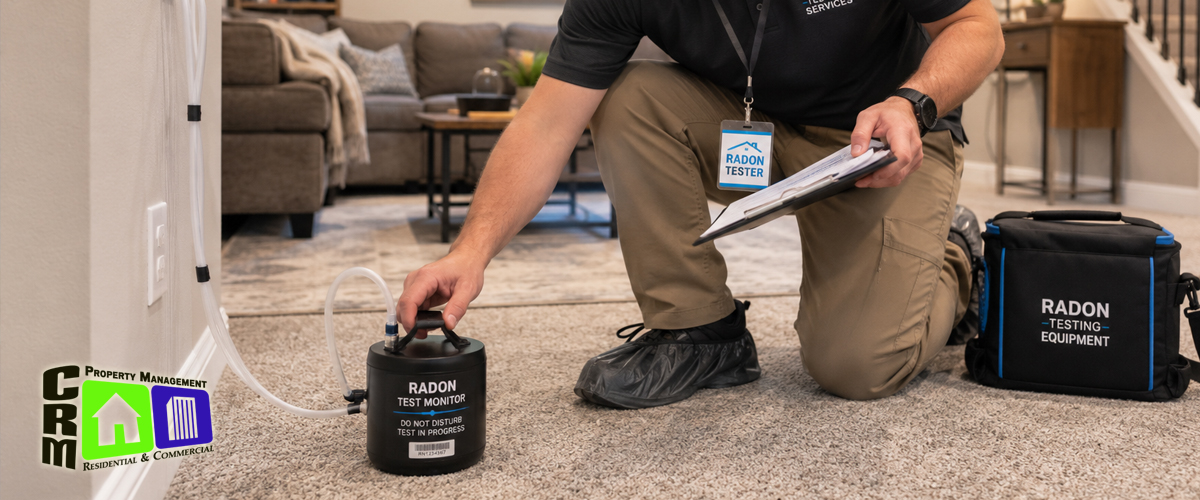
Because radon can't be detected by any of the five senses, testing is the only way to know your actual number. Utah's DEQ sells basic charcoal kits for about $11.
Short-Term Test
- DEVICE
- Charcoal canister or electret ion chamber
- BEST FOR
- Fast screening; real estate transaction timelines
- CONDITIONS
- Closed-house conditions; placed on the lowest lived-in level, away from drafts and exterior walls
Long-Term Test
- DEVICE
- Alpha-track detector
- BEST FOR
- A true year-round average, since radon shifts with the seasons
- CONDITIONS
- Normal living conditions are fine over the longer window
If an initial short-term test reads 4.0 pCi/L or higher, EPA and Utah DEQ protocol calls for a confirmatory second test before deciding on mitigation. For real estate transactions, use a certified tester (NRPP or NRSB) — Utah does not license or regulate radon testers or mitigators, so verifying credentials is on you.
How often to test
Every 2 years, regardless of a prior clean result - After any renovation, insulation, or HVAC change
- Always after a mitigation system is installed
- In the coldest months, when readings peak
- At every tenant turnover, for rental units
Fixing a high reading
What homeowners and landlords each need to know
Utah's rules are looser than most people assume — and the gap is largest for rental properties.
🏠 Homeowners Selling DISCLOSURE REQUIRED
🔑 Landlords & Property Managers NO REQUIREMENT
The other side of the argument: some property-rights advocates say mandatory testing and disclosure rules simply raise costs that landlords pass through in rent, and that Utah's current voluntary approach — including the radon notices now required on county property tax statements — appropriately leaves the decision with owners rather than regulators. Reasonable people land differently on where that line should sit. That policy debate doesn't change what a specific property's air actually contains, though — testing is still the only way to find out.
Protect Your Asset — and the People In It
Whether you own the home you live in or manage a growing rental portfolio, CRM Real Estate and Property Management can help you navigate radon testing, disclosure documentation, and next steps.